Contents
About this Document
Who is this guide for
This guide is intended for council staff who are use MobileOps to undertake inspections for Assets.
About the modules
MobileOps sends information to an operative's smartphone or tablet, allowing them to receive public reports and gather more on-site details. Operatives manage tasks, handle service requests, and conduct inspections.
To access MobileOps, download the app from Google PlayStore or Apple’s App Store.
With MobileOps, operatives can:
- Automatically view Assets and relevant information about that Asset
- Update and add information on site including inspections, tasks and risk information.
- Add assets
This allows:
- Efficient work planning to minimize travel
- Elimination of report duplication (avoiding re-entry in the office)
Internet connectivity is required, but some functions work offline, enabling operatives to record data and sync when back online.
Mobile Ops – Module Overview
Work
When a task is assigned to a user, they can view all details including location, photos, and history. Users can update and complete the task as needed.
Waste
Users have access to collection tasks organized by round and can navigate routes turn by turn while updating collection tasks with relevant information.
Inspect
Users can make observations on assets, add notes and photos, and generate associated tasks through the inspection feature of the app.
Request
Users can submit new service requests, allowing them to report issues or request additional items.
Lone
Allows a User to set an alarm, check in and raise an alarm as necessary when working in a lone setting.
Mobile Ops - Profile
Logging in and Profile
Install the MobileOps app on a smartphone or tablet with internet access.
Log in using your Admin account using the below login screen:
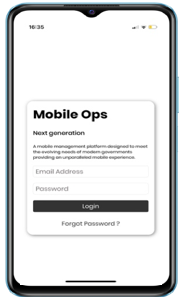
Once logged in, the Home screen appears. Select the Profile icon at the bottom of the screen.
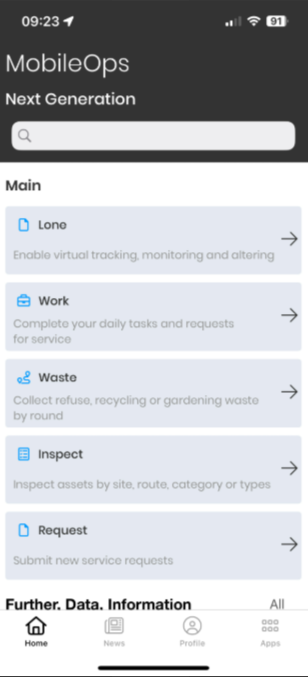
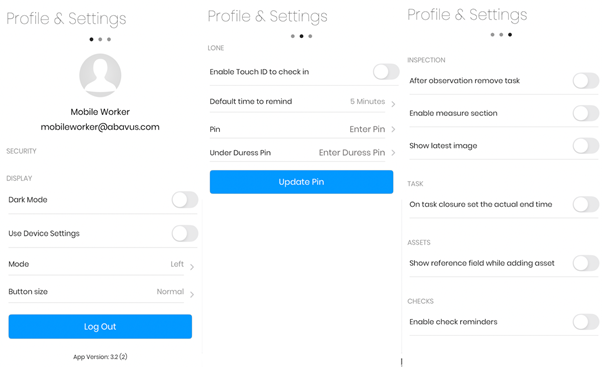
The Profile screen has three pages that you can scroll through by swiping left or right.
The initial page shows user details for the currently logged-in user. From here, a user can:
- Enable Dark Mode
- Use device settings
- Set mode to left or right
- Choose button size (Normal or Large)
- Log out
You can also view the installed app version.
Other pages offer settings for Lone Worker and Inspection, which are covered in other sections of the documentation.
Mobile Ops – Inspect
Viewing Assets to inspect
By selecting the Inspect module a User can access the necessary Assets which need to be inspected and can view all details including location, photos, and history and to add and update further inspection information.
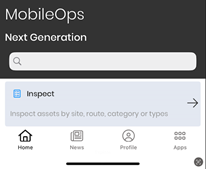
On selecting ‘Inspect’ the User can filter assets by site, asset type, category, or routes.
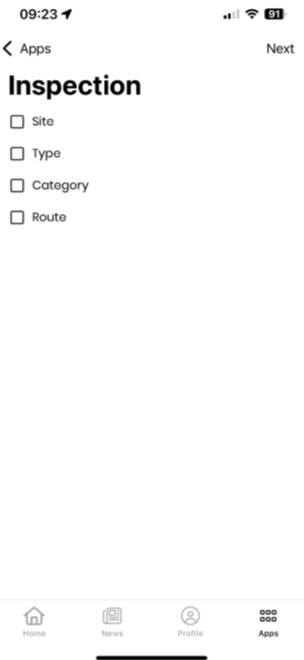
If selecting a Route, the assets will appear in the order/sequence of the Route.
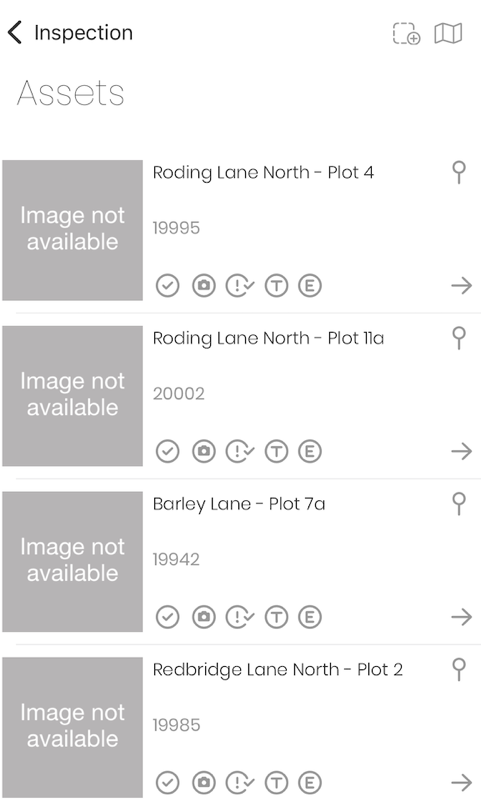
Below describes the functionality of each of the buttons:
Visited  - select this option to mark the asset as visited. The asset will be marked as completed for 24 hours before reappearing on the list.
Photo  - take or upload a photo of the asset directly to the portal, where it will be saved and accessible on your mobile device.
Inspect/observe  - add an observation of an asset. On the following screen, enter the reason, concern, cause, and action, and optionally add condition and component details.
Task  - add a task to an observation.
Express Observation  - add an ‘express’ observation to an asset to include only the Observation and further type.
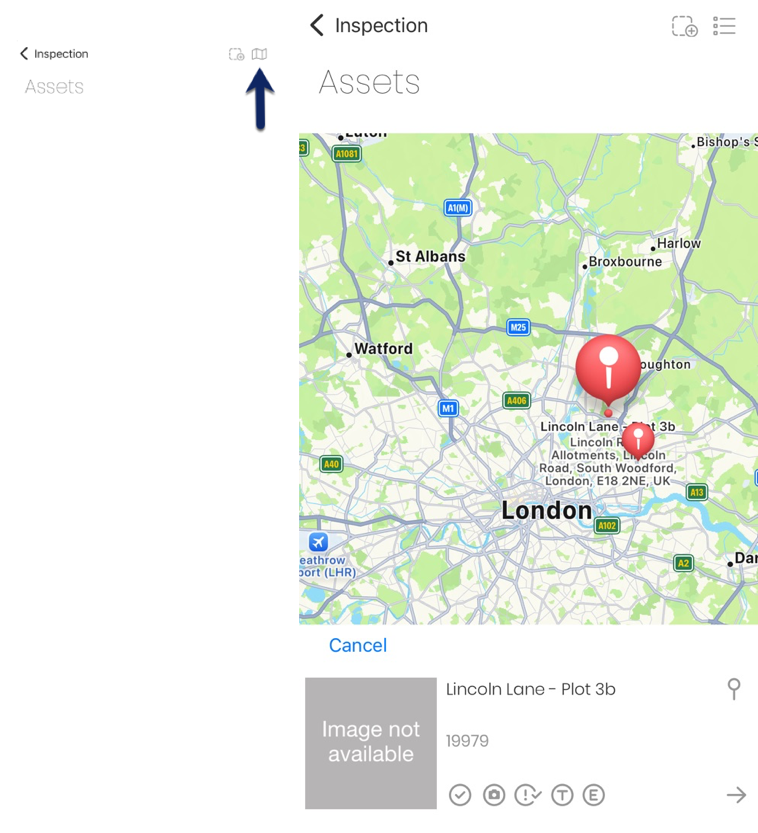
Any Assets will be visible by default as a list of Assets (view). To view on a map, select the map icon.
Assets which have a location will be visible on the map view. Select a pin to then view the Asset as per the list view.
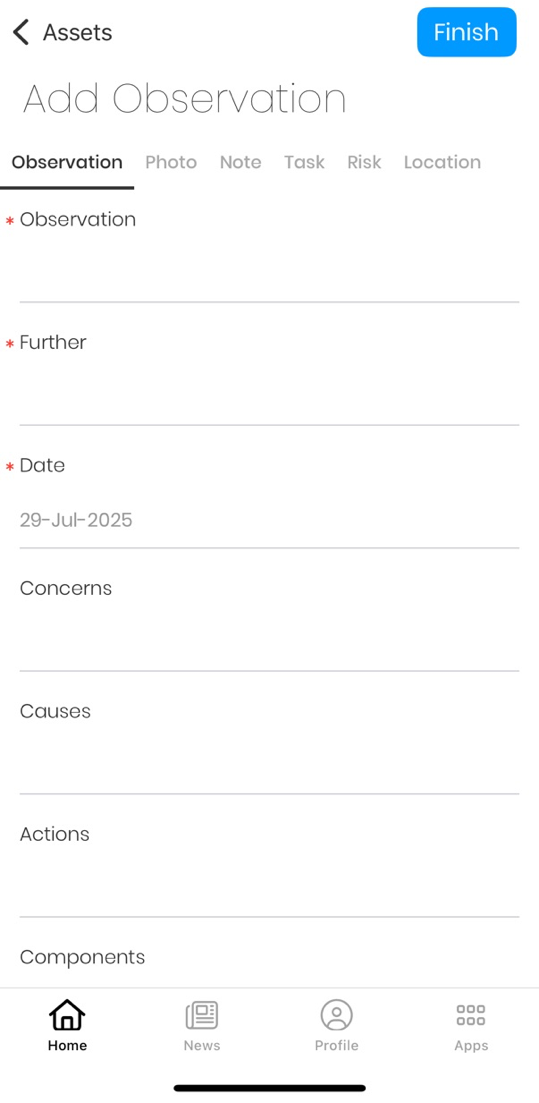
Adding an Inspection/Observation
To add an observation, select the Observation, Further and Date. Then, select any Concerns, Causes, Actions and Components. These are pre-set.
To complete an observation, click ‘Finish’ at the top or ‘Submit’ at bottom:
Photos, notes, tasks, risk and updating the location of an asset can be added/amended by doing the following:
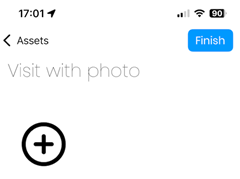
Add a photo to an observation – Tap the + button to upload a photo from your camera or gallery.
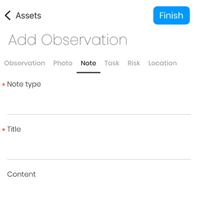
Add a note to an observation - Select the note type and enter a title and content.
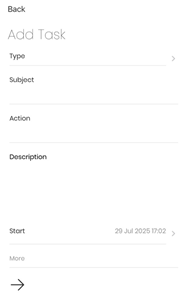
Add a task to an observation – Quickly create a task during an observation; it will link to the asset and appear in ‘Work’ on mobile devices. Choose a task type, set a schedule (e.g., “in 1 day” for tomorrow), and provide a required subject.
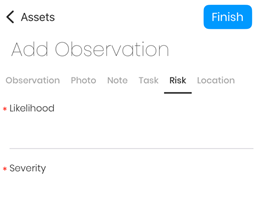
Adding a risk score to an observation – Risk can be assigned to a task, and the system will determine its priority based on probability and severity through a 5x5 matrix scoring method.
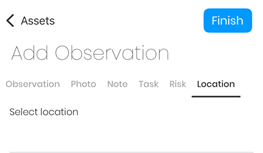
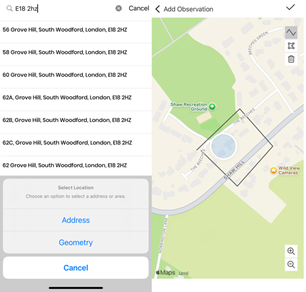
Adding/Amending a location for an asset – A location can be amended or added to an Asset. This can be added using a pin drop, selecting a postcode or drawing a geometric line around a location and selecting the tick.
 - the search icon allows a selection of a postcode.
Adding an Asset
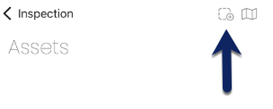
From with ‘Inspect’ Assets can be added to the system using the ‘Add Asset’ icon either located in the list or map view.
To add an Asset, enter a Name and select the Category, Sub Category and Status. Other fields are optional.
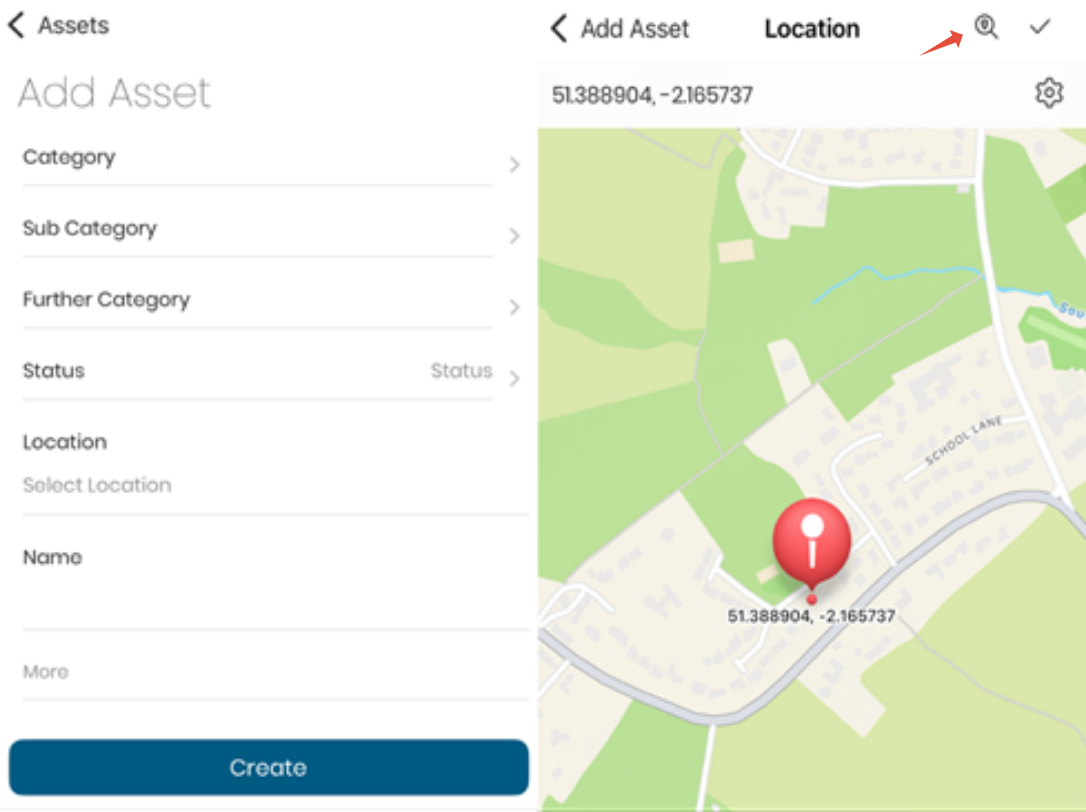
To specify a location, click ‘Location’. A location can be selected by pin drop or by searching for a postcode.
 - the search icon allows a selection of a postcode.
Offline / Low Signal - Inspections and Observations
MobileOps app supports offline data synchronization for Inspections/Observations
The following steps need to be followed for a user to work offline:
- The Asset list must be retrieved within ‘Inspect’ with network connectivity.
- A user can then undertake all operations once in offline mode
- Data can be updated while offline.
- When network connectivity is restored, the user will receive an alert to sync the data. The user can select individual tasks to sync or click Sync All on the top-right corner to sync all data with the system.
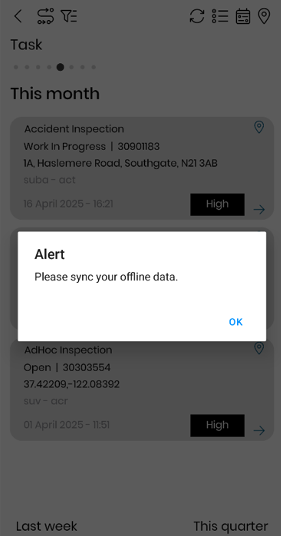
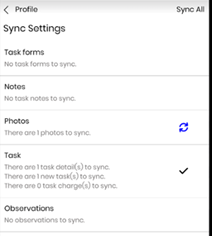
Using MobileOps offline enables operatives to continue working without a network connection by capturing updates locally and syncing later. There are a few important points to note:
- Asset data must be retrieved while online before going offline
- Once work is done, and the user has synced the data, all updates are then pushed to both the app and the back-end system.
MobileOps – Low Signal Functionality
This process manages performance in poor network conditions by assessing connection quality before actions are taken. Some characteristics of the Low Signal Functionality include:
- The app checking network quality to prevent slow or failed processes
- Sync actions are restricted if the connection is weak or unstable
- Image uploads are allowed but display a warning, as smaller uploads may still succeed
- Users are advised to switch to a stronger connection or move fully offline if needed. This avoids interrupted or partial data sync caused by unstable connections
The key difference between the Offline functionality and the Low Signal functionality is that the offline functionality is designed for working without any connection, with reliable sync later; whereas the low signal functionality is designed to manage unstable connections in real time, preventing failed or slow operations.
Was this article helpful?
That’s Great!
Thank you for your feedback
Sorry! We couldn't be helpful
Thank you for your feedback
Feedback sent
We appreciate your effort and will try to fix the article